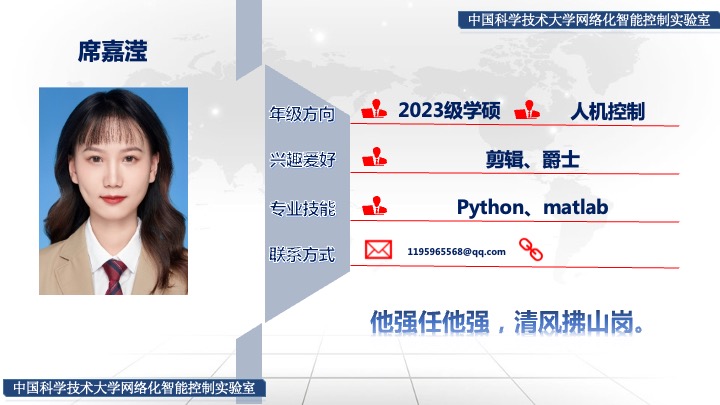
个人信息
参与实验室科研项目
基于强化学习的呼吸机参数智能精准控制技术研究
学术成果
共撰写/参与撰写专利 1 项,录用/发表论文 2 篇,投出待录用论文0篇。
patent
-
基于机器学习的呼吸机上机时间预测方法、系统、电子设备及存储介质
席嘉滢,
汤敏,
周浩泉,
and 赵云波
2025
[Abs]
[pdf]
本发明提供一种基于机器学习的呼吸机上机时间预测方法、系统、电子设备及存储介质,涉及呼吸机上机时间预测技术领域。本申请提出的一种基于机器学习的呼吸机上机时间预测技术,利用先进的机器学习和深度学习算法,结合大量的临床病例数据,训练出能够准确捕捉患者病情特征与呼吸机上机时间之间关系的预测模型,然后利用该预测模型实现对患者呼吸机上机时间的准确预测。该技术不仅能够预测患者是否需要使用呼吸机,还能够精确预测其使用时长,为临床医生提供可靠的决策支持。
Conference Articles
-
RLMV: An Algorithm for Predicting the Duration of Mechanical Ventilation in Patients
Jiaying Xi,
Yun-Bo Zhao ,
Haoquan Zhou,
Siyuan Guo,
and Chenwei Xu
In
2026
[Abs]
[pdf]
Mechanical ventilation is a supportive therapy for patients with respiratory failure, both inadequate and prolonged ventilation pose significant health risks, including increased mortality. However, the optimal duration of mechanical ventilation is difficult to predict and relies heavily on real-time clinical assessment. To address the challenge, we propose a novel predictive algorithm termed RLMV. Specifically, we represent the first attempt to integrate static physiological features with dynamic temporal variations, constructing a cascaded prediction model that combines “Feature Regression Screening” with “Temporal Deep Modeling”. Experimental results based on the MIMIC-III dataset demonstrate the superiority of RLMV, which achieving a Mean Squared Error (MSE) of 0.0032 and a Mean Absolute Error (MAE) of 0.0324 and outperforming the existing methods.
Journal Articles
-
K-CQL: An Arterial Blood Gas Analysis-Based Deep Offline Reinforcement Learning Algorithm for Mechanical Ventilation Treatment
Jiaying Xi,
Shaojie Dong,
Haoquan Zhou,
and Yunbo Zhao
Health Inf Sci Syst
2025
[Abs]
[doi]
[pdf]
Mechanical ventilation is employed as a supportive therapy for patients with respiratory failure, but the optimal ventilator settings for patient are often unknown and rely on manual adjustment by physicians. Improper parameter settings may lead to severe complications such as lung injury. To personalize mechanical ventilation and predict the optimal ventilator parameters for patients, we propose a ventilator parameter tuning algorithm. This algorithm integrates clinical expertise in ventilator tuning via Arterial Blood Gas (ABG) analysis with data-driven methods. We perform K-means clustering algorithm on patient dataset based on ABG values for the first time, and the classified data was used to train a deep offline reinforcement learning model based on conservative Q-learning (CQL), therefore we named it the K-CQL algorithm. The introduction of human expert knowledge improves the effectiveness of the entire model. Our evaluation based on Fitted Q Evaluation (FQE) on the MIMIC-III dataset shows that the expected return of the output strategy of K-CQL is 1.76 times that of the physicians, and more importantly, the introduction of intermediate rewards related to ABG analysis further improves it. We also demonstrated that the algorithm is capable of recommending mechanical ventilation parameters within a safe range according to clinical nursing standards
博客文章
学位论文
Theses
-
数据驱动的呼吸机使用辅助决策方法研究
席嘉滢
中国科学技术大学, 合肥
2026
[pdf]
毕业去向
中国华能华东分公司, 管培生